The Gloss Audit: Where a Masked-Up Used Car Gives Itself Away
There's a certain look a used car gets when someone has spent two hours on it with a bottle of glaze and a dirty microfibre. It's glossy, it's wet-looking, it photographs beautifully on Auto Trader, and it will look distinctly ordinary by the time you've driven it home and had one British drizzle on it. Gloss, unfortunately, is rentable. Correction isn't.
So if you're viewing a car in 2026 and the seller is keen to tell you it's been 'fully detailed', it's worth knowing exactly what that phrase can mean. Sometimes it means a paint depth gauge, a machine polisher and a ceramic coating. Sometimes it means a £7 hand wash and a tin of filler glaze from the local motor factors. The two look identical for about seventy-two hours.
Here's how to tell them apart without needing your own polisher.
Start with the awkward bits, not the bonnet
Everyone strokes the bonnet. Nobody checks the door shuts. That's precisely why the door shuts are where a rushed job falls apart.
Open every door fully and look at the inner shut faces — the painted strips between the door and the sill, plus the area under the rubber seals. On a properly corrected car these have been decontaminated, dried and protected to the same standard as the exterior. On a masking job they'll often still hold traffic film, water spotting, or a fine line of dried polish residue wedged into the seam where the polisher never reached.
Look at the trailing edge of each door, the leading edge of the rear arches, and the panel edges around the boot lid. Fillers and glazes get pushed into these areas and then dry white in the gaps. If you see chalky white residue in panel gaps, in the shut lines, or around the base of the wing mirror, someone has been in a hurry. That's not necessarily a dealbreaker, but it tells you the 'detail' was a surface-level effort.
Wheel arches: the 10% nobody photographs
A genuine detailer spends a silly proportion of their day on parts of the car you'll never see in a listing photo. Wheel arch liners get cleaned. The backs of the wheels get cleaned. The calipers get cleaned. The area behind the arch lip — the bit that collects grit and rots quietly — gets cleaned.
On a merely valeted car, the faces of the alloys will be spotless and the inner barrels will be black. Run a finger inside the arch liner; if it comes away gritty, the car has had a cosmetic wash, full stop. Also look at the wheel weights and the tyre sidewalls. Dressing slung onto the treads and the weights is the signature of someone who sprayed it on and walked away.
While you're down there, check the tyre dates. It's not a paint issue, but it's the same story: a seller who skips the boring bits on the outside is likely to have skipped them everywhere else.
Glass, trim and the fine mist of overspray
Glass is honest. Look at it at a low angle in daylight and you'll see water spots, wiper marring and a faint film that a quick wash won't shift. Properly detailed glass is clear right to the edges, including the top corners of the windscreen where nobody bothers.
Then check the trim. Rubber seals, the plastic scuttle panel, the window surrounds. If they're jet black and slightly greasy, they've been dressed — possibly minutes before you arrived. That's fine on its own, but dressing over faded or contaminated trim is a cover-up. It'll go patchy within a fortnight.
And look for polish residue on textured black plastic. White speckles in the grain of the bumpers, the mirror caps or the door handles are the classic tell of a machine polish done without masking. A professional tapes those areas up. Someone chasing a quick forecourt shine doesn't.
The swirl question, honestly answered
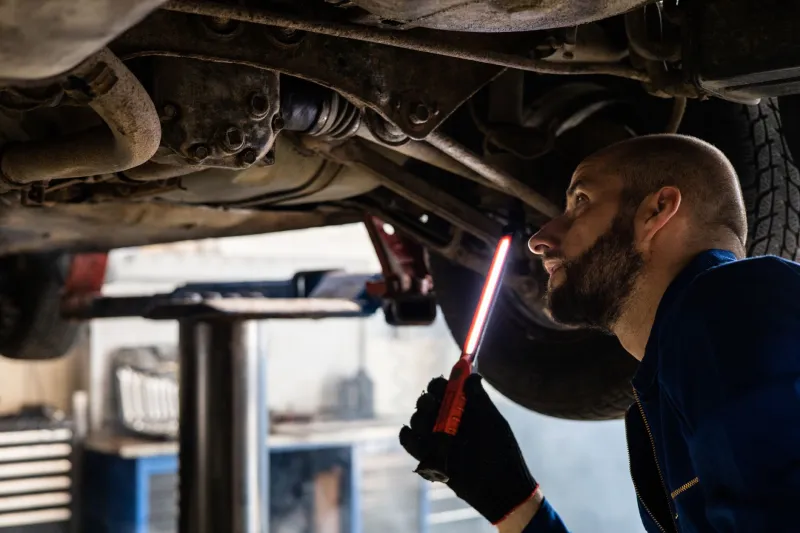
Here's the thing nobody in the trade likes to admit: a car can look superb and still be swirled to death. Glazes fill swirls; they don't remove them. Under a bright forecourt light, or a petrol station canopy at night, filled paint looks flawless. Under an LED inspection torch at a shallow angle, the truth appears — thousands of fine circular marks, holograms from a rotary polisher, or the odd pigtail from a stray bit of grit.
You don't need a detailing torch to do a decent check. Take the car into direct sunlight at a low angle, or use the torch on your phone held almost parallel to the panel. If the reflection looks like a scratched CD, the paint hasn't been corrected; it's been masked. It may still be a perfectly good car — but price it accordingly.
What a proper inspection actually includes in 2026
A legitimate pre-purchase detail inspection should be more forensic than theatrical. At minimum, expect:
- A paint depth gauge reading across every panel, so you know what's original and what's been painted.
- An IPA or panel-wipe down on a test area, which strips oils and glazes and reveals what's actually underneath.
- Panel gap and shut-line checks, including under the bonnet and around the boot.
- Glass and trim assessed separately, not just wiped over.
- A conversation about what the car needs versus what it's been given.
If a seller can't tell you whether the car has been machined or merely glazed, that's your answer. Enthusiasm is not the same as evidence.
The bottom line
Buy the car, not the shine. A genuinely detailed used car will have tidy door shuts, clean arches, unmasked trim and paint that holds up under a harsh light. A masked one will look incredible for a week and then quietly revert to the swirls it was hiding all along.
If the gloss is rented, ask what it's hiding. If the seller doesn't know, assume the worst and negotiate like it.