Half a Micron of Truth: The Problem With Your Mate's Miracle Polish
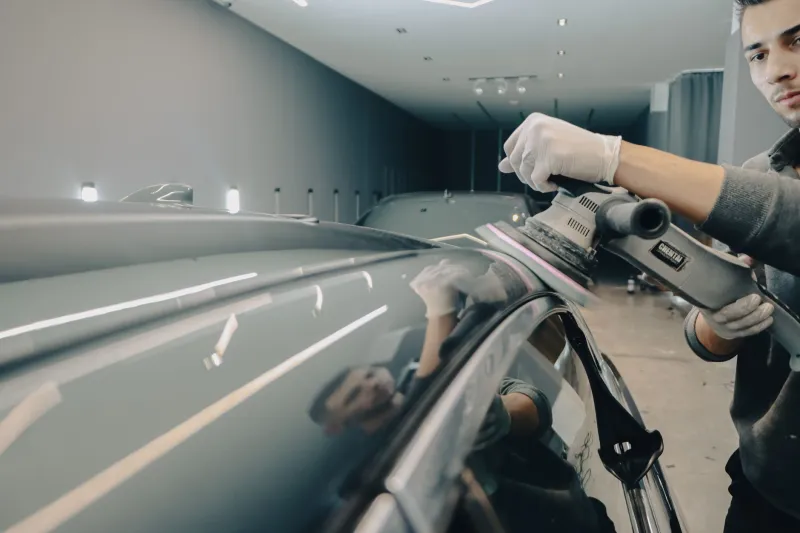
We've all met him. He's leaning on a fence at a Sunday meet somewhere between Warrington and Wakefield, gesturing at a bonnet that catches the light in a way that suggests either a miracle or a lie. "One-pass polish," he says. "Bought it from the motor factors. Fifteen quid. Took the swirls straight out."
He's not lying, exactly. He's just describing something that isn't happening.
What Swirl Marks Actually Are
Swirl marks aren't dirt. They're not a film. They're physical damage — thousands of microscopic scratches in your clear coat, usually inflicted by a rotary brush at a hand car wash or a dirty sponge and a bad attitude. When light hits them, they scatter, and the paint loses that deep, wet gloss that makes a car look cared for.
The only way to remove a scratch is to remove the paint around it until the surface is level again. There is no bottle that does this in one pass. There is barely a bottle that does it in five.
The Half-Micron Problem
Here's the number that ends most arguments: modern clear coats typically measure somewhere between 35 and 50 microns thick. For scale, a human hair is roughly 70 microns. Your paint's sacrificial layer is thinner than the hair on your head, and every correction pass removes a little of it.
A proper dual-action machine with the right compound might level a light scratch in two or three passes. A heavy defect might need a cutting compound, a refining pad, and then a finishing pass to restore gloss. That's not marketing — that's geometry.
So what's happening when your mate's £14 polish "works"? Usually one of three things:
Filler technology. Most one-step polishes from the high street are loaded with oils and fillers that temporarily sit in the scratches and refract light more evenly. It looks corrected for a fortnight, then the first decent wash with a snow foam and a pressure washer strips the oils and the swirls come back like a bad reunion tour.
Abrasion that's barely abrasion. Some "polishes" are closer to glazes — they clean and shine but remove almost nothing. Nothing in, nothing out.
He's looking at a dark car in a shaded car park. Swirls on a silver Astra under an overcast sky in Salford are remarkably forgiving. Park the same car under the strip lights of an underground car park and the truth reappears.
When One Step Actually Is Enough
To be fair to the bloke by the fence: a light swirl on a soft, thick clear coat, caught early, genuinely can be improved with a single machine pass of a mild polish. If your car is two years old, washed properly by hand, and just showing the first hint of marring, a careful one-step with a DA polisher is a legitimate approach.
But that's not what most cars need. Most cars we take in have been through the tunnel wash a hundred times, been sponged with the same bucket of murky water since 2019, and carry paint that's been machine-buffed badly at least once by someone who watched a video. That's not a one-pass job. That's a measured, multi-stage correction — compound, refine, finish — with paint depth readings taken first so we know how much we're working with.
The Honest Test
Want to know if a polish actually corrected anything rather than filled it? Do this:
- Polish a test section on the bonnet.
- Wash the car properly two weeks later — proper two-bucket method, or a foam pre-wash.
- Check the same section under direct sunlight or a halogen inspection lamp.
If the defects are back, you bought a filler. If they're gone, congratulations — you had a genuinely light defect and a decent product. Either way, you've learned something for the price of a wash.
Why This Matters More Than the Bottle You Buy
Clear coat doesn't grow back. Every correction session spends a finite budget, which is exactly why the pro approach is: correct once, properly, then protect — a ceramic coating or a quality sealant — so you're never paying to fix the same scratches twice.
So next time someone at the pumps tells you they sorted their paintwork in a Saturday afternoon with a bottle from the retail park, be polite. Nod. Then book a paint depth reading and find out what's actually left to work with. The paint doesn't care about opinions — only microns.